

Product Management with AI
The programme learning will pause for holidays during Christmas (24 Dec 2026 – 1 Jan 2027) and Chinese New Year (5 Feb – 12 Feb 2027).
Future-Proof Your Career
Emeritus and Singapore Management University unite to offer an exclusive opportunity. Enroll by Invalid liquid datausing the code: APAC4PERCENT3232 and receive a 4% program fee benefit. Limited seats are available. Reserve your spot today!
What is the Product Management with AI Programme About?
The programme covers the business and governance dimensions of AI, including AI economics, ROI, P&L, product metrics, infrastructure costs, responsible AI, security and privacy. Industry expert masterclasses offer practical perspectives, while an end-to-end Capstone Project enables participants to conceptualise, design and prototype a responsible AI-first product for a real-world opportunity.
90%+
73%
84%
Why Choose SMU Product Management with AI Programme?

AI-First Product Management
Learn Gen AI, Agentic AI, Multimodal AI and AI-native product development.

End-to-End AI Product Lifecycle
Go from opportunity discovery to strategy, prototyping, GTM and scaling.

15+ AI Product Tools in Action
Hands-on learning with AI tools, agentic workflows and AI-native PRDs through demonstrations and examples.

Live Online Sessions
4+ live sessions by faculty and industry expert to gain insights on emerging AI tech, product innovation & more

Real-World AI Product Capstone
Build an AI-first product addressing a real-world opportunity.

Smarter AI Business Decision-Making
Apply AI economics, ROI, P&L, CAC, LTV, GMV and infrastructure costs.

Responsible AI Product Building
Build responsibly with AI governance, security and privacy.

SMU Associate Alumni Status & Benefits
Access SMU Associate Alumni Status & peer networking opportunities.
Singapore Management University Advantage
#5 Globally
#2 in Asia
#5 in Asia
What skills will you gain from the Product Management with AI Programme?

Assess the suitability and limitations of AI technologies including Generative AI, multimodal AI, and Agentic AI for different product contexts.

Identify and prioritise AI product opportunities based on customer needs, business value, feasibility, and data readiness.

Develop business cases and roadmaps for AI products by considering costs, returns, unit economics, and key trade-offs.

Design and prototype AI-first products, features, and agentic workflows using appropriate product, UX, data, and human-oversight principles.

Plan the development, launch, and scaling of AI products using agile, experimentation, go-to-market, and stakeholder-management practices.

Measure and improve AI product performance using relevant product, model, and agent metrics.

Apply responsible AI and governance principles to address bias, privacy, security, compliance, accountability, and user trust.
Who should apply to the SMU Product Management with AI Programme?
Mid-Career Product & Digital Professionals
For professionals across product, digital, tech, and strategy roles who want to transition from traditional approaches to AI-first product development, leveraging AI to build better customer experiences.
How this programme delivers value:
Builds practical fluency and hands-on exposure to emerging AI technologies (including GenAI and Agentic AI) for core product workflows.
Translates customer and business problems into AI-powered product solutions.
Equips you to design, launch, and scale AI products while strengthening your financial and business strategy capabilities.
Senior Product, Technology & AI Leaders
For experienced leaders in product, engineering, data, and innovation seeking to formalise their AI expertise, evaluate emerging technologies, and drive responsible AI adoption across their organisations.
How this programme delivers value:
Bridges technical AI expertise with overarching product strategy and measurable commercial outcomes.
Develops frameworks to evaluate AI investments, workflows, ROI, and business value.
Equips you to lead responsible AI development while staying current with trends like LLMs and Multimodal AI.
Product Management with AI Programme Curriculum
Module 1: The AI-First Product Manager
Evolution of product management: traditional PM to AI-first and agentic PM
The AI-first PM mindset: intelligence-driven and agent-driven products versus feature factories
Core skills for the modern PM: technical fluency across ML and agentic systems, business acumen and ethical judgement
Business-case fundamentals: ROI, payback period, cost–benefit analysis and AI/agent infrastructure costs
Anatomy of digital products: e-commerce, marketplaces, platforms, SaaS and consumer apps
Impact of AI and automation on PM responsibilities, tools and team dynamics
Module 2: AI Technologies for Product Managers
Supervised, unsupervised and reinforcement learning: what PMs need to know
Recommendation systems, AI search ranking and personalisation engines for digital products
LLMs and agentic systems: reasoning, planning and tool use
RAG, fine-tuning, prompt engineering and agentic tool use: when to use each
Multimodal AI: image, video and voice applications in e-commerce and digital experiences
Data science and ML collaboration: model lifecycle, evaluation metrics and bias awareness
Module 3: Agentic AI and Autonomous Product Workflows
Agentic AI: from copilots to autonomous, goal-directed systems
Anatomy of an AI agent: planning, memory, tool use and reasoning loops
Autonomous product workflows: guardrails, escalation paths and success metrics
Multi-agent systems and orchestration in digital product experiences
Autonomy levels: copilots, semi-autonomous and fully autonomous systems
Module 4: AI Product Discovery and Opportunity Analysis
Customer research methods: ethnography, interviews, surveys and session recordings
Jobs-to-be-done framework for digital and AI product discovery
AI-powered and agentic customer research: sentiment analysis, review mining and behavioural analytics
Market sizing for digital and AI products: TAM, SAM and SOM
Competitive intelligence using AI research agents: automated benchmarking and desk research
Customer segmentation and AI-assisted persona building
Module 5: AI and Digital Product Ideation and Business Case
Product opportunity gaps and the problem–find–solve approach
Ideation frameworks: design thinking, How Might We and AI-assisted ideation
AI-assisted product concepts: the need–form–technology nexus
Scoping AI and digital product opportunities: feasibility, viability and desirability
Minimum Viable Product development
P&L interpretation for product managers
Unit economics for digital and AI products: CAC, LTV, GMV, margins and cost per agent task
Module 6: AI-Driven Product Strategy and Roadmapping
Product portfolio strategy and lifecycle management for digital and AI products
Positioning digital and AI products: competitive differentiation, category creation and uniqueness
AI-enabled market and competitive intelligence for product strategy
AI-assisted roadmapping with agentic planning copilots
Prioritisation frameworks: RICE, MoSCoW and opportunity scoring with AI
AI product opportunity prioritisation: value, feasibility, data readiness, risk and strategic alignment
AI product monetisation and business models: freemium, subscription, usage-based and outcome-based agent pricing
Dynamic and AI-driven pricing for e-commerce and digital platforms
Module 7: AI Product Design and UX
Conversational and action-based agent UX patterns
Product-vision communication with UX design teams using agentic AI design tools
Product-vision development through real-time user feedback
Prototyping with Figma for digital and agentic product flows
Module 8: Data and AI Readiness for Product Analytics
Instrumentation fundamentals: event tracking, funnels and session data for digital products
SQL for product managers and natural-language and agentic querying
North Star metrics, KPIs and AI and agent performance metrics: accuracy, latency and task-success rate
AI and agent readiness: data infrastructure, quality and governance prerequisites
Data-informed product dashboards
Module 9: AI-Driven Product Delivery and Agile
Lean and agile product development for AI and agentic feature delivery
Agile Scrum philosophy and methodology for AI and digital product teams
Cross-functional collaboration: engineering, data science, design, legal and finance
Agentic systems in agile workflows: planning, quality assurance and delivery
Risk, accountability and control in agent-assisted product execution
Module 10: AI-Powered Product Launch and Go-to-Market
Go-to-market strategy for AI-powered and agentic digital products
Product-led growth principles and AI- and agent-driven acquisition loops
Market understanding: AI opportunity sizing and competitive benchmarking at launch
Launch metrics, success criteria and post-launch iteration planning
Case study: go-to-market strategies for AI-first and agentic digital products in Southeast Asia
Module 11: AI Product Performance and Optimisation
AI product performance measurement through product, model and agent metrics
AI feature evaluation across accuracy, quality, latency, cost and task success
AI feature monitoring and performance diagnosis
AI-specific failure modes and uncertainties
User feedback, experimentation and online evaluation
AI feature optimisation: behaviour, guardrails and fallback experiences
Product decisions based on performance evidence and trade-offs
Module 12: AI Product Development, Automation and Delivery
Rapid prototyping using LLM APIs, no-code AI builders and agent frameworks
AI workflow design and multi-step orchestration
API, retrieval, tool and enterprise-system integration
MVP strategy for AI features: building the smallest useful intelligence
User validation of AI features and pre-production iteration
Module 13: AI-Driven Personalisation and Engagement
Personalisation using user context, embeddings and behavioural signals
Recommendation and ranking systems for engagement and discovery
Continuous learning using feedback loops
Experimentation for AI features: A/B testing, contextual bandits and online evaluation
GenAI and agentic personalisation: conversational recommendations and next-bestaction experiences
Business-impact measurement: engagement, conversion, retention, LTV and task success
Module 14: Building AI Products and Features
Translation of selected product ideas into AI features and product-level specifications
AI product requirements across the model, data and context, user and product-system components
AI-native PRDs as a method for formalising product requirements and dependencies
Product-manager-led prototyping for testing product assumptions, feasibility and user value
Iterative validation and refinement of AI features before production
AI-specific failure modes and uncertainties in product development
Product-requirement and design refinement based on prototyping insights
Module 15: Responsible AI, Governance, Security and Trust
Algorithmic bias and fairness in recommendation, search and pricing systems
Dark patterns and consumer protection in AI-driven digital products
Data privacy and regulatory compliance
AI and agent security: adversarial attacks, prompt injection and tool-misuse risks
Transparency, explainability and user consent in AI and agentic features
Case studies involving organisations such as Amazon, the FTC and the SEC
Platform examples including Microsoft Copilot and ChatGPT
Module 16: Product Leadership and Stakeholder Management
Strategic thinking and business acumen for senior PM influence
AI and agentic capabilities translated into business value and executive communication
Stakeholder management: alignment across engineering, design, legal, finance and leadership
Product operations: tools, processes and rituals for high-performing AI and digital product teams
AI-first and agentic-first product-team development and mentoring
Product-impact measurement and communication: revenue, retention and adoption
Module 17: Scaling AI Products and Future Product Innovation
Platform thinking: scaling digital and AI products and building ecosystem value
Multi-agent ecosystems and platform-scale orchestration systems
Self-improving product systems powered by autonomous feedback loops
Innovation frameworks for continuous product evolution
Market understanding: the evolving competitive landscape for AI-first digital products
Agent-native product organisations and operating models
Module 18: Capstone: Build and Prototype an AI-First Product
End-to-end agentic product-system design and prototyping from discovery to deployment
Product discovery, strategy, design, development, validation and governance integration
Product concept, feature specifications, prototype and implementation-roadmap presentation
The AI PM Toolkit for Modern Product Leaders















Notes: All product and company names mentioned in this material are trademarks or registered trademarks of their respective holders. Their use does not imply any affiliation with or endorsement by them.
Meet the Faculty

Prof. Shantanu Bhattacharya
Professor of Operations Management; Deputy Dean (Education); Academic Director, PhD in Business (General Management)
A leading academic in operations management, he holds a PhD in Operations Management from The University of Texas at Austin. His research spans new product development, innova...

Dr. Markus Karner
Academic Director, SMU Executive Development
Originally trained as a STEM scientist, he brings an interdisciplinary perspective to strategy, business model innovation, design thinking, systems thinking and organisational...

Associate Faculty Vasanth Seshadri
Associate Faculty, Singapore Management University, Executive Development (ExD)
He is an advertising creative director and founder with an Executive MBA from Singapore Management University (SMU). With a keen interest in the intersection of creativity and...

Dr. Tamas Makany
Associate Provost (Teaching and Learning Innovation); Director, Centre for Teaching Excellence; Associate Professor of Communication Management (Education)
An expert in cognitive psychology, he holds a PhD from the University of Southampton. His research examines human-AI communication, human-computer interaction, design educatio...

Prof. Kapil R. Tuli
Lee Kong Chian Professor of Marketing; Deputy Dean (Research)
A marketing scholar with a PhD from Emory University, his research focuses on marketing strategy, customer relationships, customer solutions, branding and the financial impact...

Prof. David Gomulya
Professor of Strategy & Entrepreneurship; Academic Director, Master of Science in Entrepreneurship and Innovation
He holds a PhD in Strategic Management and Technology Entrepreneurship from the University of Washington, with research spanning entrepreneurship, corporate governance, strate...

Dr. Patrick Tan Siong Kuan
Senior Lecturer of Strategy & Entrepreneurship; Course Coordinator, Strategy
With a PhD in General Management from Singapore Management University, his areas of expertise include corporate strategy, entrepreneurship, international business, strategic k...

Prof. Ted Feichin Tschang
Associate Professor of Strategic Management; Course Coordinator, Sustainability
Holding a PhD in Public Policy and Management from Carnegie Mellon University, his research explores digital transformation, human-AI interaction and work, innovation, design ...

Prof. Yuanto Kusnadi
Associate Professor of Accounting (Education)
He holds a PhD in Finance from the Hong Kong University of Science and Technology. His research and teaching span corporate finance, accounting, corporate governance, financia...

Prof. Pradeep Reddy Varakantham
Professor of Computer Science; Coordinator, BSc (CS) Artificial Intelligence Track; LSEI Fellow
He received his PhD in Computer Science from the University of Southern California. His research interests include artificial intelligence, machine learning, sequential decisi...

Dr. Kiruthika Ramanathan
Senior Lecturer of Information Systems; Director, MITB (Digital Transformation) Programme; Faculty Manager, IS Project Experience (Applications)
She received her PhD from the National University of Singapore. Her teaching and academic interests include digital technologies and transformation, enterprise solution manage...
SMU Associate Alumni Status and Benefits

Latest updates from SMU publications such as Keep Up (OAR quarterly alumni e-newsletter), SMU Engage (SMU e-newsletter) and Lift Up (Alumni Giving e-newsletter)

Invitations to exclusive professional or networking events

Up to 20% discount** on Lifelong Learning (Open Enrolment) Programmes offered by SMU Executive Development

Discounts and exclusive promotions at participating merchants.
*Kindly be advised that these benefits are subject to change.
** For selected programmes only. Only one discount applicable per registration. Multiple or combined discounts are not accepted
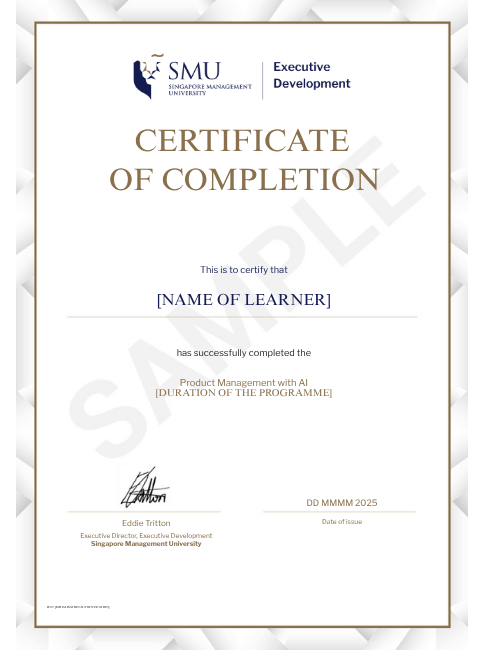
Programme Certificate
Upon successful completion of the programme, participants will be awarded a verified digital certificate by Singapore Management University.
FAQs
What is the SMU Product Management with AI programme?
The SMU Product Management with AI programme is an 18-week executive education programme delivered online, with 4+ Live Faculty and Industry Expert Masterclasses. It teaches product professionals to build AI-first products using Generative AI, Agentic AI, and Multimodal AI, covering the full product lifecycle from discovery to scaling, and ends with a hands-on capstone project.
Who should apply to this AI product management programme in Singapore?
This programme suits mid-career professionals transitioning from traditional to AI-first product management; and senior product, technology and AI leaders scaling AI adoption. It is delivered by SMU in Singapore and well suited to professionals based in Singapore and across Asia-Pacific.
What is agentic AI in product management, and why does it matter?
Agentic AI refers to autonomous, goal-directed systems that plan, use tools, and complete multi-step tasks with minimal human input. Agentic AI for product managers means designing workflows, guardrails, and escalation paths around these systems. A dedicated module in this programme covers agentic AI and autonomous product workflows in depth.
How do I become an AI product manager?
Becoming an AI product manager typically means building on product management fundamentals with AI-specific skills: agentic workflows, AI-native PRDs, prompt engineering, and AI business economics. This programme is structured to build exactly this capability over 18 weeks, whether you are transitioning from a traditional PM role or starting out in a digital or AI-adjacent function.
What does an AI product manager do differently from a traditional product manager?
An AI product manager designs and ships AI-powered features, evaluates AI and agent performance metrics like accuracy and task-success rate, and builds business cases around AI infrastructure costs and responsible AI practices such as bias mitigation and governance, alongside the usual product discovery, roadmapping, and stakeholder work of a traditional product manager.
What AI tools does an AI product manager need to know?
This programme gives hands-on exposure to 15+ enterprise AI tools spanning product management (Productboard, Craft.io), analytics (Mixpanel, Amplitude, Google Analytics), AI models (Claude, ChatGPT, Gemini, Perplexity), no-code building (Lovable, Bolt.new), automation (n8n, Zapier, Make), and design (Figma), the practical toolkit modern AI product leaders are expected to use.
Do I need a technical background for this AI product management programme?
No coding background is required. The programme is designed for product, digital and business professionals at any career stage, from mid to senior leadership, and builds technical fluency in AI concepts, tools, and agentic workflows as part of the curriculum itself, rather than assuming it going in.
What skills will this AI product management programme help me build?
Participants build an AI-first and agentic product manager mindset, learn to run AI-powered product discovery, build business cases using AI infrastructure ROI and unit economics, design and ship AI features through AI-native PRDs, and apply responsible AI governance: the core skill set behind current AI product manager roles.
What will I build in the capstone project of this AI product management programme?
Participants complete an end-to-end capstone project where they conceptualise, design, and prototype an AI-first digital product addressing a real-world opportunity, applying discovery, strategy, prototyping, and responsible AI governance skills built across the 18-week programme.
What credential do I receive, and is the SMU Product Management with AI programme worth it?
Participants who successfully complete the programme receive a verified digital certificate of completion from Singapore Management University, along with SMU Associate Alumni Status and its benefits, including discounts on future SMU Executive Development programmes, for professionals looking to build AI-first product capabilities backed by a recognised university.
Early registrations are encouraged. Seats fill up quickly!
Flexible payment options available.
Starts On