

Strategic Leadership With AI
- Learn from a Triple Crown Accreditation University
- Implementation Frameworks and AI Tools
- Led by Senior SMU Faculty with Industry Expertise
- Certificate from Singapore Management University
The programme learning will pause for holidays during Christmas (24 Dec 2026 – 1 Jan 2027) and Chinese New Year (5 Feb – 12 Feb 2027).
Future-Proof Your Career
Emeritus and Singapore Management University unite to offer an exclusive opportunity. Enroll by Invalid liquid datausing the code: APAC4PERCENT3232 and receive a 4% program fee benefit. Limited seats are available. Reserve your spot today!
What is the SMU Strategic Leadership with AI Programme About?
AI isn’t coming. It’s compounding. The pilots are done. The real question surrounding AI for senior executives is who will architect the advantage when intelligence becomes embedded across the enterprise? This is where Strategic leadership with AI shifts from experimentation to orchestration, redefining capital allocation, competitive moats, and governance in an age of autonomous systems.
Singapore stands at the frontier of this transformation, pairing rapid innovation with world-class governance. It offers a living laboratory for leaders shaping an Enterprise AI Strategy that balances speed, scale, and accountability, from agentic ecosystems to sovereign AI capabilities. Delivered by Singapore Management University—one of the few institutions in Asia to hold the prestigious "Triple Crown" accreditation (AACSB, EQUIS, and AMBA)— the Strategic Leadership with AI programme lays out the roadmap for AI for business leaders who are ready to move beyond adoption toward reinvention, building intelligent enterprises, redesigning operating models, and leading confidently into the algorithmic decade.
How SMU's Strategic Leadership with AI Programme Redefines Executive Advantage?

15 Cutting-Edge Modules
Learn AI strategy, LLMs, RAG, Agentic AI, governance and transformation.

10+ Global Case Studies
Analyse real-world AI strategy, deployment and governance in action.

Implementation Frameworks and AI Tools
Coverage of key implementation frameworks, with references of relevant AI tools for contextual awareness.

1-Week Capstone Project
Build a comprehensive AI strategy for a real-world business challenge.

Live Faculty-Led Sessions
Participate in live, interactive sessions led by distinguished SMU faculty, focusing on industry relevant topics.

Certificate from Singapore Management University
Earn a verified certificate of completion from a globally recognised, Triple Crown-accredited institution.
The AI Technology Stack You Will Explore






Notes
All product and company names mentioned in this material are trademarks or registered trademarks of their respective holders. Their use does not imply any affiliation with or endorsement by them.
The sessions will offer tools overview only.
The tools and platforms referenced are free versions intended solely for educational or illustrative purposes. No subscriptions will be provided.
The tools and platforms mentioned are subject to change and will be finalised prior to the start of the programme.
The program offers a strategic overview and conceptual exploration of key AI tools and platforms, demonstrating their relevance for leadership decision-making.
Learn from Globally Renowned SMU Faculty

PROF. LAURA WYNTER
Associate Professor of Computer Science (Practice), SMU School of Computing and Information Systems
Ex-head of IBM Research Lab in Singapore, Prof. Laura Wynter teaches and works in the field of Generative AI. She has launched research initiatives and startups in agentic AI ...

PROF. SUN SUN LIM
Lee Kong Chian Professor of Communication and Technology, SMU College of Integrative Studies, SMU Vice President
Professor Sun Sun Lim researches the social impact of technology, focusing on family dynamics and ethics. From 2018-2020, she was a Nominated Member of the 13th Parliament of ...

DAMIEN KOPP
Managing Director, RebootUp | Associate Faculty, SMU Executive Development
Damien Kopp is a global technology advisor and educator based in Singapore. He leads RebootUp, a boutique advisory practice focused on AI strategy, governance, and the geopoli...

IDA CHAO KHO
Member Singapore Institute of Directors
Ida Chao Kho is a senior legal, policy, and governance expert specialising in AI governance, data privacy, cybersecurity, and responsible technology adoption. She is affiliate...
How This Curriculum Builds Enterprise AI Leaders?
Module 1: Introduction to AI - Fundamentals for Leaders
Understanding AI. Distinguish between traditional AI and Generative AI
Historical overview of AI from traditional AI to Generative AI
Module 2: Deep Learning and Text Generation
Demystifying Deep Learning for Business Leaders
Neural Networks without the math
Text generation and language models
Module 3: Understanding Large Language Models (LLMs)
Understand AI and Large Language Models (LLMs)
How GPT, Claude and Gemini work
Capabilities and limitations of LLMs
Module 4: LLM Training, Evaluation and Deployment
How and why training and LLM work, without the math
Customising an LLM, via training and fine-tuning
Evaluating the LLM after training or customising without training
Deploying a customised LLM
Module 5: Retrieval-Augmented Generation (RAG)
Understand RAG architecture and why it matters for enterprise AI
Master vector databases, embeddings, and retrieval strategies
Evaluate RAG system performance with key metrics
Design and deploy RAG for your organisation
Module 6: Agentic AI
What defines an autonomous AI agent
Agent design: memory, planning, feedback loops
Tool orchestration: APIs, LLMs, systems
Multi-agent collaboration and coordination
Module 7: AI Across Business Functions (strategic applications)
Strategic AI Opportunities in HR (talent, workforce planning, productivity)
Strategic AI Opportunities in Finance (forecasting loops, risk, performance)
Strategic AI Opportunities in Marketing & Sales (signals, orchestration, conversion)
Strategic AI Opportunities in Supply Chain (forecasting, routing, exception handling)
Cost vs Revenue Prioritisation for Functional AI Initiatives
Designing Cross-Functional AI Workflows and Intelligence Loops
Breaking Functional Silos Through Agent-Enabled Decision Flows
Leadership Actions for Aligning Functional AI to Enterprise Transformation
Gen AI and Agentic AI Applications in Marketing, Sales, and Customer Experience
Enhancing Finance, Risk Management, and Supply Chain with AI and Agentic AI
Leveraging AI and Agentic AI for HR Transformation and Talent Strategy
Leading AI and Agentic AI Initiatives Across Business Functions
Driving Operational Efficiency Through AI and Applied Agentic AI
Module 8: AI in Products & Services
Transitioning to AI-Enhanced Services and Offerings
Building Product-as-a-Service Models enabled by Intelligence Layers
AI for Smarter Logistics, Inventory, and Adaptive Operations
Scaling AI Across Products and Service Lines (platform architecture)
Design for Hyper-Personalisation and AI-Augmented Product Innovation
Agent-Based Recommendation Engines and Self-Optimising Delivery
Designing Data Feedback Loops to Improve Products Continuously
Module 9: Generative AI Strategy and Industry Use Case
Industry-level GenAI use cases and competitive dynamics (Retail, CPG, BFSI, Manufacturing, Public Sector)
Prioritisation frameworks for GenAI portfolio selection (value, feasibility, risk, data readiness)
Enterprise integration patterns: RAG, retrieval quality, workflow orchestration, validation layers
Model strategy: open-source, API, hybrid, sovereign cloud, on-prem trade-offs
Data, infrastructure, and operational dependencies (security, latency, cost, compliance)
Guardrails for accuracy and reliability (hallucination controls, sandboxing, quality gates)
Governance alignment with local guidelines, compliance framworks and enterprise AI policies
Enterprise roadmap: pilots → platform → scale; capability maturity and operating model choices
Module 10: AI Strategy and Business Transformation
AI as a Central Business Strategy
Crafting an AI Vision and Strategic Narrative
AI-Driven Business Model Reinvention
AI Portfolio Strategy: where to play and how to win
Agent-first Strategy: redesigning decision flows and leadership responsibilities
Building strategic moats in the AI-driven economy
Enterprise readiness for AI-led reinvention
Module 11: Sovereign AI
AI Value Chains and National Strategies
AI as Narrative Amplifier (and Distorter)
Weaponisation of AI Technologies
Building Resilient, Sovereign AI Systems
Practical Sovereignty for Corporates: What ‘Sovereign AI’ Means at the Enterprise Level
Module 12: AI Implementation & Organisational Alignment
Scaling AI Projects from Pilots to Enterprise Platforms
Building a Robust Data Strategy for AI (quality, lineage, governance, accessibility)
Operational Readiness for AI Deployment (integration, monitoring, security)
Structuring AI Teams & Operating Models (CoE, federated, hub-and-spoke, platform)
Cross-Functional Collaboration Models
Measuring AI Success (ROI, KPIs, adoption, performance)
Agent Lifecycle Management (monitoring, controlling, orchestrating autonomous systems)
Module 13: Leadership for Change Management in the Age of AI
Leading Organisational Transformation in the Age of AI
Fostering a Culture of Curiosity, Experimentation, and Psychological Safety
Addressing Fear, Resistance, and AI Anxiety
Communicating AI Initiatives with Clarity and Credibility
Embedding AI into Change Programs and Leadership Rituals
Redesigning Leadership Roles in Hybrid Human–Agent Organisations
Building Trust in Agentic Systems: Transparency, Accountability, and Boundaries
Module 14: Human–Agent Collaboration & the Future of Work
Designing AI-Augmented Teams and Hybrid Roles
Preparing for Job Evolution in the Age of AI
Building AI-Centric Upskilling and Reskilling Strategies
Redesigning Performance and Talent Metrics for the AI Era
Human–Agent Collaboration Models: AI as colleagues, not just tools
Module 15: Responsible AI, Ethics & Governance
Identifying and Mitigating AI Bias, Fairness, and Ethical Risks
Navigating Privacy Regulations and Compliance in AI
Promoting AI Transparency and Explainability
Ethical risks in Agentic AI — runaway autonomy, decision accountability
Establishing Effective AI Governance Frameworks
Capstone Project
Build a comprehensive AI strategy for a real-world business challenge in a 1-Week capstone project.
Is This the Right AI Programme for Business Leaders Like You?
This Strategic Leadership with AI Programme is designed for forward-thinking professionals who recognise AI as the new operating system of business.
Senior Professionals: Leaders shaping organizational strategy and focusing on ROI, governance, and sustainable business models beyond the hype.
Mid-Career Professionals: Individuals seeking to pivot or drive operational excellence and focusing on practical frameworks, workflow redesign, and leading hybrid teams.
Technology & Transformation Leaders: Professionals bridging business and tech and focusing on deepening their understanding ofenterprise-grade architectures like RAG and Sovereign AI for scalable implementation.
Case Studies





Strategic Frameworks for Accountable AI Leadership

NIST AI Risk Management Framework
A lifecycle-based governance model structured around Govern, Map, Measure and Manage to ensure resilient, trustworthy AI oversight.

IMDA Model Governance Framework for AI Agents (Jan 2026)
A forward-looking framework focused on accountability, human oversight and control in autonomous and agentic systems.

ASEAN Guide on AI Governance and Ethics
A principles-based reference guiding responsible AI adoption across diverse regulatory and cultural environments.
What Skills Will You Develop from the SMU Strategic Leadership with AI Programme?
By joining this cohort, technical leaders will bridge the gap between coding and corporate governance. They will leave equipped to architect a secure Enterprise RAG strategy and implement a Sovereign AI strategy that strictly adheres to IMDA AI governance and NIST AI Risk Management frameworks.
By the end, you will be able to:
Explain core AI, generative AI, and agentic AI concepts for enterprise leadership.
Evaluate risks, governance, and reliability of enterprise AI systems.
Assess enterprise-grade AI and agentic system architectures.
Identify, prioritise, and justify high-impact AI initiatives.
Evaluate and architect AI-enabled product, service, and business model transformations.
Lead AI strategy, implementation, and organisational transformation.
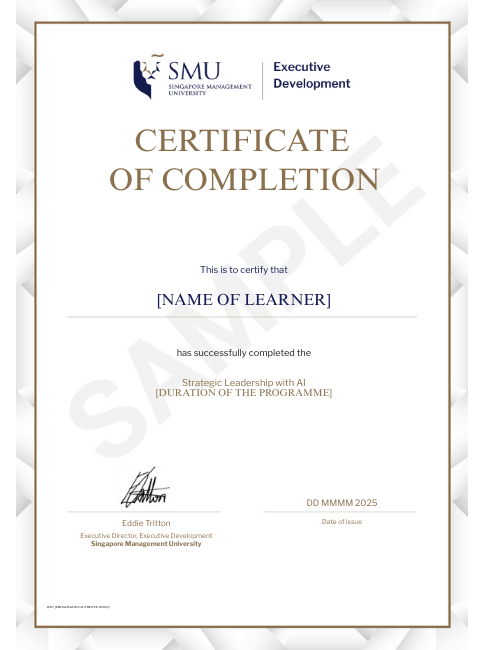
Celebrate Your Achievement with an SMU Online Certificate
Upon successful completion of the programme, participants will be awarded a verified digital certificate by Singapore Management University.
FAQs
What makes the SMU Strategic Leadership with AI programme unique?
This 17-week executive programme moves beyond basic adoption. It uniquely combines frontier technology like an Enterprise RAG strategy with world-class governance frameworks, including IMDA guidelines, equipping you to orchestrate scalable AI solutions and lead hybrid human AI teams effectively.
Is this Strategic leadership with AI online programme suitable for non-technical leaders?
Yes. The curriculum is designed specifically for AI for business leaders and senior executives. It focuses on Enterprise AI Strategy and governance rather than coding, bridging the gap between technical possibilities and strategic business execution without requiring any prior programming experience.
How does this programme compare to other AI executive education options?
Unlike broad overviews, this rigorous AI executive education programme provides deep strategic application. By analysing key tools and frameworks, participants move beyond theory to understand and evaluate enterprise-grade AI architectures for global business environments.
How does the curriculum address AI governance and Sovereign AI strategy?
Governance is a core pillar. The programme leverages Singapore’s forward-looking regulatory environment, teaching you to navigate the NIST Risk Management Framework and IMDA AI governance. You will learn to implement a compliant Sovereign AI strategy that balances rapid innovation with accountability.
What is the expected time commitment for this AI transformation programme?
The programme is structured for busy senior professionals. It requires a manageable commitment of 4-6 hours per week over 17 weeks. This allows you to gain proficiency in Agentic AI for leaders and complete the practical 1-week capstone without disrupting your executive responsibilities.
Can international participants join this programme from outside Singapore?
Absolutely. As a premier AI for business leaders online experience, the 17-week format is designed for global accessibility. While anchored in robust governance frameworks like ASEAN and IMDA guidelines, the strategic focus and global case studies apply universally to global enterprises.
Will I interact with Singapore Management University faculty during the programme?
Yes. The learning journey includes live, interactive sessions led by distinguished SMU faculty. This ensures you receive expert, industry-relevant insights while acquiring the skillset to build a comprehensive Enterprise AI Strategy tailored specifically to your organization's real-world challenges.
What is the ultimate goal of developing expertise in Strategic leadership with AI?
The ultimate goal is moving from experimentation to orchestration. Strategic leadership with AI empowers you to redefine capital allocation, redesign operating models, and build an intelligent, secure enterprise, positioning your organization at the forefront of the algorithmic decade.
Early registrations are encouraged. Seats fill up quickly!
Flexible payment options available.
Starts On